The Fiona hap-inspired shawl/throw has been on my mind for a long time, and I’m thrilled that it is now available and waiting to get onto your looms.
Inspired by traditional knitted haps, pin-loom woven Fiona playfully blends fabric textures and colors – authentically worked in Shetland wool – into a lightweight warming accessory that can be used as a wrap, shawl, or cozy throw.
Fiona is a contemporary take on the rich history of Scottish haps: Instead of knitting, this pattern uses pin-loom woven hexagons to create a center square, surrounded by colored borders. Lace effects are distrbuted throughout the piece by weaving the yarn on different-sett pin looms. The hexagon shapes naturally add the peaked edging.
Using authentic wool elevates the weaving experience and perfects the wearability of this hap. The finished Fiona measures about 60″ x 64″ and weighs only about 500g (less than 18oz).
Please feel free to contact us if you have any questions, or leave a comment below. Happy weaving!
Special thanks go to photographer Gale Zucker, www.gzucker.com, Instagram @galezucker, models Josephine Ankrah, Instagram @sweetjsphn,Yliana Mancini, Instagram @missladybugg95, and Gale’s team (including her dog Jack) for capturing Fiona in all the ways I had envisioned.
I also want to thank Bonnie Visser for helping me with weaving the hexagons. Your weaving is meticulous!
October is a big month for many crafters: The heat of the summer is gone and the desire to pick up those pin looms and some scrumptious fibers returns. It’s the perfect time to start holiday crafting!
Over the years I have observed in online forums that this is also the time when people ask for small projects of which they can make multiples … for friends, colleagues, or family gatherings. I looked for such projects in the Little Looms library and put a selection together. You can find this month’s project picks and much more pin-loom weaving information on the Pin Loom Weaver’s Guide on the new (!) Little Looms website.
These projects are small enough that they will – once December comes – also make great last-minute crafts that you can even complete on your way to a gathering. I chose to name this selection “Crowd-Pleasers and Last-Minute Gifts”. I hope you will enjoy!
Extra Tip: Show off your hand-spun! All these projects use only small amounts of yarn. Consider using your hand-spun fibers to share the results of your spinning skills with loved ones.
Here is your next Deborah Bagley pattern: Do you make your own syrup, or beer, or wine? Or maybe you discovered a great beverage this year, and you’d like to share that with special people in your life? Make it extra special with a hand-made, reusable bottle cozy.
Tips:
Personalize the cozy by using the recipient’s favorite colors.
Use a special yarn/color to “brand” your creation.
Make some extra cozies to be prepared for unexpected invitations.
Former Handwoven editor Susan Horton contributed this project to the first Little Looms Holiday issue in 2020. This issue and the Holiday 2021 issue are loaded with celebration ideas. I hope that you will take a look and maybe get inspired even beyond pin looms!
Don’t stop at magnolias, as gorgeous as they are:
Weave these flowers in any colors worth celebrating.
Add some sparkly beads for the centers.
Dive into your stash and use up some of your already woven squares.
Use the flowers as brooches, hair clips, or make unique and reusable decorations, for example to top off a present or make a garland.
It is true that I have not chosen any hexagon project this month. There is a joke going around that I cannot design small projects, which of course is not true. It is a co-incidence that there hasn’t been a super-small hexagon project in Little Looms (yet). But don’t despair … just browse this blog! Since we’re approaching the holidays, how about the 24 project ideas from our 2017 Advent Weave-Along? And sign up to our newsletter so that you don’t miss any future project ideas …
Congratulations, Barbara Ruuska, you are the winner of our Weaver’s Guide Launch giveaway! Please check your email for more information.
Have you heard? The Little Looms magazine now provides a free Confident Weaver’s Guide to Pin Loomon their website, and the TURTLEs and I are proud to sponsor the launch.
I think there is no doubt that Long Thread Media has gathered an impressive amount of high quality information since they started 10 years ago, created by a team of passionate fiber and publishing experts and curated tastefully by their incredible editor Christina Garton. It is even more precious (and humbling) for a small community like pin-loom weavers to receive such attention.
However, with this treasure trove of information comes the question – particularly for a beginning pin-loom weaver – where to start. This is where the Weaver’s Guide steps in. View it as a well organized introductory gateway to pin-loom weaving for beginners, and for advanced weavers it will serve as an easy-to-use platform to quickly find information and inspiration.
The guide is organized in sections that round it all up: Getting Started and Basics, Yarn and Tools, Finding a Project, Joining Pieces, Finishing Ideas, Tips and Troubleshooting, and Going Beyond, or Watch and Learn pin-loom video courses.
Meet a Special Feature
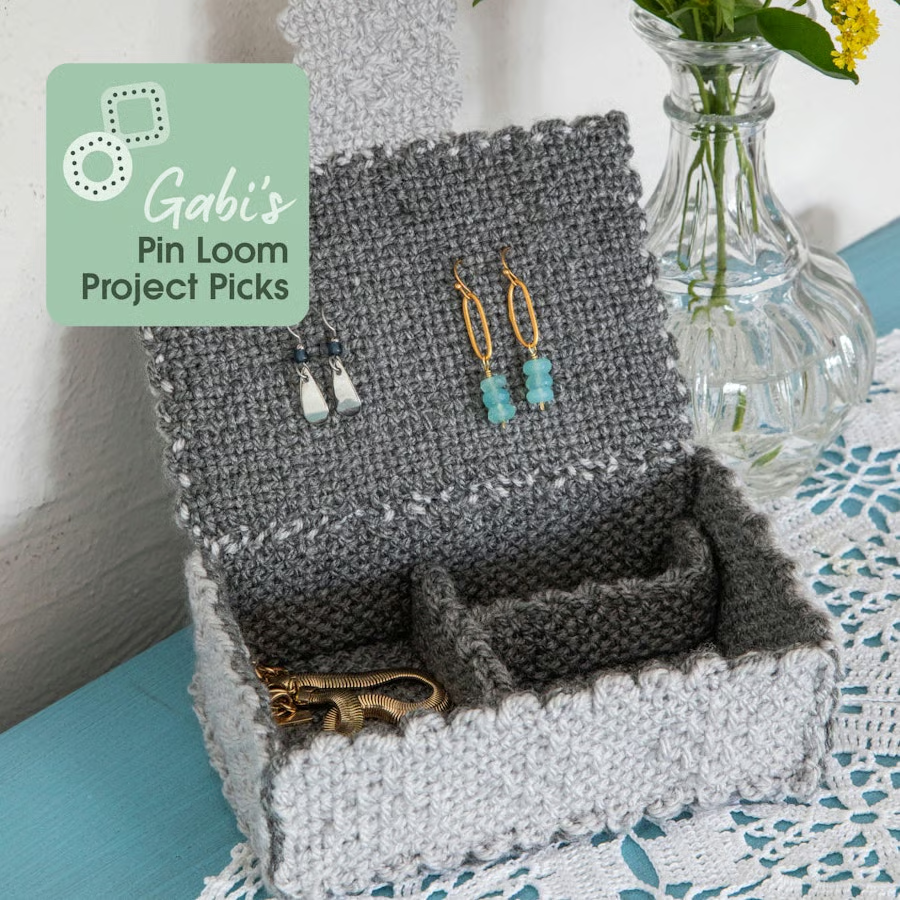
Sponsoring means that we help to make it possible to put all of this together. However, the Little Looms team and I decided to do more. You will see “Gabi’s Picks”, where every month I will highlight a few of the over 170 pin-loom weaving patterns and add a little story. Take a look at the August picks and read their story!
What About the Banners?
The TURTLEs and I firmly believe in providing wholesome solutions.
I’m a Maker. I make pin looms. It started with the patented hexagon and jewel-shaped looms, and we made them suitable for a large variety of yarns. And then arose the desire to add shapes that will work together with these looms for even more design options. You can see all the looms that we currently make in our Loom Catalog or visit the Bluebonnet Crafters store on Etsy to make a purchase.
I’m a Designer. The first hexagon loom was born out of the dilemma that I could not find the loom that I needed (you can hear the story in this Long Thread Podcast episode). As a lifelong crafter I often have ideas on what I want to make and then find a way to make it. When successful, I delight in sharing those ideas with others. This is why you can find over 30 of my contributions in the Little Looms library, and more than 200 more project ideas here on the blog, on Ravelry (you have to login to see the list), and on other sources like the Schacht website (Entrelac-Style Cowl and Autumn Cross-Body Pouch) .
I’m an Instructor. Sharing knowledge has become a big part of my daily routine. Each of our looms comes with written instructions, and our Bluebonnet Crafters YouTube channel features dozens of videos with instructions and project ideas for TURTLE and other looms. Contact me any time if you have a specific question. I’m also a member of these pin-loom communities on Facebook or Ravelry that I can highly recommend … maybe I’ll see you there!
Comment for a Chance to Win
Still reading? Yay! I hope that the Weaver’s Guide will amplify your love and appreciation for pin looms.
I’m very interested to hear any comments or questions that you may have about this new resource, please comment below! What do you like about the Weaver’s Guide? What do you not like? Should there be more/less of …? Would you like to see added …?
THE GIVEAWAY IS NOW CLOSED, but feel free to comment or ask anything at any time … thanks for joining the fun!
The TURTLEs told me that I need to add a raffle for your effort, so on the last day of August 2026 I will ask Mr. Random to select a name out of those who left a comment, and this person will win a TURTLE loom of their choice. The giveaway is open to all and the winner will be announced here on the blog early September.
There’s almost nothing that you can’t make with pin looms. Meet Joe the lonely goat marionette, which was inspired by the lonely goatherd story in the “Sound of Music”.
Three looms help to shape the head and the body, and flexible legs and neck:
Worsted weight yarn for body and head ensures a solid fabric that holds the stuffing, fingering weight yarn for the legs and the neck, woven on a regular sett loom, provide just enough fabric to connect the pieces but are bendable enough to enable the marionette to move. I used Signature Blend by The Rogue Skein for a most natural look, but you can substitute and use your favorite yarn or some precious handspun.
Joe is easy to weave and craft, even for a beginner who just wants to set out to explore marionette making. The 20-page pattern provides photo-guided step-by-step instructions for:
How to make the goat
How to make a simple cross bar for handling a four-legged creature, and
How to string up and test the marionette.
Use the basic marionette construction of this pattern to make other creatures, too, for example a horse, unicorn, cat, dog, giraffe, and many others.
For my current pin-loom weaving project I am modifying the Ditta Vest pattern to weave a jungle scene. The story behind it? I recently saw a knitted vest with a pocket to hold a small matching stuffed animal.
I decided that a vest with pockets would be a great way to enjoy those ornaments beyond displaying them on my Christmas tree.
Stuffed animal Hector snug into the picture to guard the loom.
I chose several different colors of Handspun Hope’s Organic Merino in worsted weight for the design to make a tree for the gorillas, and a meadow for the giraffe.
Allow me a quick note … if you look closely at the following picture, you will see that the purple yarn is slightly thicker than the others. This showcases another benefit of pin-loom weaving handspun yarns (more in the recent Spin Off podcast post):
The loom determines the shape and size of your weaving.
Even if you weave with yarns that vary in thickness, the pieces will all work together in your project just fine!
I will post photos of the finished vest here on the blog … I hope you’ll come back to see it!
We are sponsoring the podcast because we think it is one of the best, covering a broad range of interesting and entertaining topics from the fiber world.
How does Spin-Off relate to pin-loom weaving? Boy, just ask our customers! I did a Blitz call for customer photos last week on how TURTLE loom weavers use their looms for their handspun yarns, and here are some examples:
UK-based TURTLE loom user Claire Cryer contributed the header photo for this post. She adds “All handspun by me, and most of the dyed bits are hand dyed by me too. It’s a good way to use leftovers and experiments.” She used the TURTLE Elongon loom and no pattern, but if you are interested in a similar project, take a look at the “Painted Pillow” pattern in the Little Looms Holiday 2021 issue.
Customer Kim Chase is an all-trades fiber lover who is also very creative when it comes to recycling fibers. For this spinning adventure she re-spun a blend of fibers from different sources. Kim’s candle doily would make a great first project for a beginner. Kim also turned a boring shopping bag into an eye-catching accessory by crafting puffed hexagons for an extra 3D effect.
A hexagon flower is a versatile, beginner-friendly project.
Hexie flower doily.
Kim’s special hexipuff bag decoration.
Fiber recycling …
Plyed and ready to weave.
Australian crafters Tamantha Gilfoyle and Kaye Martin are a team: Tamantha spun the fibers and Kay wove them. Here are some of the results:
The star is woven on the TURTLE Original Diamond.
Kaye likes Bronson Lace and has tested different yarns on the TexaTURTLE.
I include Carolyn Blakelock‘s contribution with special emphasis on her “delicious” way of storing her woven pieces in biscuit boxes! Carolyn writes “When I learned to spin, one of the first things I did with my handspun was reach for my pin looms, and I love using up my leftovers on the pin looms. For my thicker yarns I use my square zoom loom, and for my thinner yarns I use my Turtle Loom Hexi. I keep my finished squares in Godiva biscuit tins, to keep them safe from little critters until I have enough to make something.” Great reason to eat more cookies!
Canadian customer Pat McDonald is a winner of the Garment Challenge that we organized a few years ago (see our ad in Little Looms Spring 2025). Pat has crafted a good number of garments and accessories using pin looms. Note how she combines different crafts for her hat!
Hexagon medley
Brown hat and scarf.
Blue scarf.
Beverly Anglin, who has designed numerous adorable projects for the Schacht Zoom loom, contributed this picture of a shawl where she combines handspun and commercial yarns. The pattern is Meg Stump’s “Night Covers the Earth” shawl from her “Pin Loom Weaving to Go” book.
Elise Mann bought some handspun and -dyed yarn locally in the UK, and she thinks that she will have just enough to weave a scarf on her triangle pin loom. It sure looks pretty!
All photos are courtesy of their respective owners and used with permission.
I hope that you enjoyed reading about these examples. Ready to give pin-loom weaving a try? Check out our loom catalog! Contact me if you have any questions.
It all started with this little patriotic heart coaster that I doodled together a few weeks ago. Then I thought it would be nice to write the pattern so that others can weave hearts as well.
Little did I realize that this would turn into an instructions series about pick-up pattern weaving using the continuous-strand weaving method on square looms, supported by seven new videos!
There are very few resources available for weaving pick-up patterns using the continuous-strand weaving method on square pin looms, and I quickly realized that there was a lot to explain before I could share my heart pattern. In this post you will find tips and tools that go beyond just one square loom. I hope that you will enjoy these new resources!
Continuous-strand weaving is typically done on looms with equidistant pin setting (the pins are evenly spread out along the sides).
However, I’ve tried to provide instructions that go far beyond just one loom so that you can apply the principles to similar looms.
Pick-up patterns for pin-looms most commonly weave over/under three threads, though longer floats are possible. The limited number of strands to work with on these little looms and the typically thicker fibers compared to what is used on traditional large looms make 3-strand floats a good choice to show as much “pattern” as possible in a limited space. These instructions use 3-stand floats throughout to keep the demonstration simple to follow.
Now let’s start the journey:
Challenge: Square Looms with Different Pin Setts
There are no traditional standards for square looms with equidistant pin setting like there are for the Weave-It method (pin looms with the classical 3-pin grouped setting). This also means that pin setts and loom sizes vary greatly. Writing a pattern that depends on a proper number of warp and weft threads therefore is of very limited use.
To solve this dilemma I decided to show how you can make a design template for any loom. Once you have that, you can more easily adapt a pattern to your loom and design your own patterns:
I recommend to start with weaving a plain square.
On the loom, slide the fabric up as high as possible.
Take a picture and optionally apply a high-contrast black/white filter.
Save this image as a reusable image for a blank template. You can print copies and color them in or use online painting apps to mark up a copy.
Such a template is useful to count warps and wefts, design cross-stitch patterns, and more.
Next, weave a square with an all-over pickup pattern. The easiest is an all-over honey comb pattern:
Weave the first five rounds as usual in plain weave. Note that you could start the pick-up pattern after just two rounds, but I recommend to add a plain weave border for a nicer edging.
On the next round, weave U1, O1, U1, … O3, U1, … O1, U1, O1 to the end.
For the continuous-strand weaving method you need rounds of plain weave between pattern rounds, so weave one round plain.
On each following pattern row, start the same pick-up sequence U1, O1, U1, then add repetitions of (O3, U1) to the last three strands and end in O1, U1, O1. The rows are getting longer because you have more warps from the previous weaving. Just repeat U1, O3 until you get to the last three strands.
Don’t forget to weave plain rows between pattern rows.
Continue to repeat the last two rounds. The final round should be plain weave to ensure pattern symmetry throughout the square. If your weaving doesn’t end on a round of plain weave, consider skipping the last round or weaving one more round in the beginning before you start the pattern weaving.
Weave the last pattern row.
Photograph your honeycomb square and make a design template as described above. Additionally, mark the line where you wove the last row. That’s your first geometry axis. Optionally you can mark the other diagonal as well for fully symmetrical motifs and to make counting easier.
Use this template to easily convert pick-up patterns to your loom and design your own patterns.
Here are video instructions that show how to weave the all-over honeycomb pattern. Shown are righthanded instructions, lefthanded instructions are available as well.
Challenge: Pattern Symmetry
Take a minute to understand how patterns develop on a continuous-stand woven square.
As is is common to continuous-stand weaving squares, what you weave at the beginning of a round “copies” automatically to the opposite side of the loom when you complete the round.
This means that any pattern stitches that you weave will automatically copy in reverse row sequence to the other side of your future fabric. The final row of the square serves as the geometry axis to join the two halves.
You only design half of a square (the upper right triangle) and the rest will fill in automatically in reverse row sequence as you weave.
That makes it easy to design patterns that are symmetrical in all directions, like a diamond. You plan the upper half of the shape and the lower half will automatically copy as you weave.
See in this video how you can try this out using your new template to design a pick-up pattern:
Challenge: Weaving a Shape with One Symmetry
Pattern design becomes a little more complex for motifs that only have one symmetry axis. The key is to align the symmetry axis of the design with the last row of your square weaving. Then the same rules that are explained above apply.
To weave the heart, you will now start each row weaving differently than ending it.
Here is a chart that shows the pattern for a heart on the Square 4″ R loom (righthanded view).
Weave plain weave for the areas outside the pattern.
To easily find out the row where you need to start the pattern weaving, count the pins!
This video shows how to weave the heart shape. Shown are righthanded instructions. Lefthanded instructions are available as well.
Challenge: Using Two Colors
Any pick-up pattern will look good in a solid color, but you may need to look twice to see the pattern.
You get a much more vivid effect if you use two colors.
Weaving a two-colored continuous-strand square requires a few extra steps:
To get a single strand at the beginning of the weaving, start with one color at the bottom corner (closest to you) and guide up a single strand to the top corner. Think of it that you weave half a round instead of a full round. Then start the second color at the top corner and weave the next round as usual. This will add one warp strand to your total count. You can add that to your design planning, or weave another template, this time using two colors!
Change colors every round in the same manner to avoid a frilled edging:
At the end of a round, guide the current working yarn between the last pin that has yarn on it and the next pin.
Switch yarns by guiding the next color OVER the previous color (the new color “traps” the old color).
To start the next round, guide the new color around two pins to get ready for the weaving.
Weave as usual, starting with going under the first thread. End each weaving with going under the last thread before fetching the working yarn.
And here we are finally reaching the pattern that started it all!
The following information puts it all together … how to weave a continuous-strand pick-up pattern on a square pin loom … with one symmetry axis … in two colors.
I invite you to download the written and charted weaving instructions for weaving a small pick-up heart pattern on the TURTLE Square 4″ R loom.
The final video shows the weaving for the heart pattern in two colors step by step. Shown are righthanded instructions, lefthanded instructions are available as well.
Bonus: Opposite Sides with Opposite Looks
When you weave a pick-up pattern, there is no right or wrong side. You will notice that the front and the back of your woven piece look different. The floats on the front (in the example heart pattern) will show horizontally on the front and vertically on the back. If you wove with two colors, the pattern shows in one color on the front and in the other color on the back. Feel free to mix and match those sides in your project!
Solid color, front.
Solid color, back.
Two colors, front. Pick-up is woven in green.
Two-colors, back.
There’s so Much More
There is so much more to write about but I tried to keep it reasonable. I invite you to ask questions in the comments section. Making all this information fit into one blog post has been a challenge on its own, and if something is not clear or I missed something that is important to you, please let me know and I will do my best to answer.
No matter which fiber craft you pursue, swatching is always a big topic. Why you should swatch … why people don’t swatch … and if you do swatch, what do you do with your swatch afterwards?
I’m a big swatching advocate. Simply speaking, I like to know before I spend hours and ours on crafting how a fiber will work and wash.
Pin-loom swatching results similar benefits as other fiber crafts. It takes just a few minutes to weave up a hexagon, and then you:
Know what it feels like to work with the yarn,
See if the sett is right or if you need to make adjustments or choose another loom,
Can quickly try different weaving methods and patterns, and
Get get a first glimpse of what the fabric will look like.
This is not only of interest for a pin-loom project but it may be useful for other weaving. Weaving up a little piece of fabric in no time may give a first impression of the fabric that you want to make on a rigid-heddle or multi-shaft loom. It will not replace sampling on that loom, but it may help with planning a project.
Using the Original TURTLE Loom in F-fine sett and R-regular sett I wove sample hexagons for each of the 13 skeins, sewed them together and blocked them.
I like to create a fabric instead of blocking pieces individually if I can, because that shows how the hexagons work together across seams.
But then I had this 13-piece, 3-row-something swatch and was wondering what to do with it. Swatches can always be part of a great patchwork blanket, but this swatch was big enough to become its own project … I decided to make a small project bag and here is what I did:
Fold the swatch fabric in half, right side facing in.
The red lines indicate where to sew the sides together. I used whip stitch.
For the handles I found some bamboo rings … they measure about 4.5″ in diameter. You could also use some rope or pretty ribbon!
Add a handle by folding the flap of the hexagon at the open edge over the bamboo ring and secure the folded hexagon along three sides as shown.
Turn the right side out, and you’re done!
The bag measures about 10″ wide at the widest point and is ideal for a pin-loom project or small (sock) knitting project. Lining is optional, but if you transport needles or small, thin items, you may want to keep them in a small Ziplock bag.
While I have always enjoyed designing and making quilt-inspired pin-loom projects, I usually don’t “quilt” them, which means adding a backing with some batting in between, and then stitching all layers together.
I’ve done some tie-quilting, where every few inches apart you pull and tie off a piece of string through all layers.
During my recent visit to the International Quilt Festival, seeing all the quilting equipment, I started to wonder if or how machine quilting might work for pin-loom woven tops.
I decided to ask the Gammill quilting equipment experts at the show; the company had sponsored all Open Studio sessions, including mine.
What started as a question turned into a proof-of-concept experiment … with a stunning outcome.
I showed Gammill representative Sue Kleinschmidt one of my woven projects that I had brought to the Festival, and she suggested that we could try quilting a smaller sample, which I agreed to put together. Sue also suggested to stabilize the fabric with light interfacing, and I just happen to have some at hand from another project.
I wove a flower like for the Flower Garden Throw, but with one ring only, using the same Ad Astra cotton that I had used for the original project. After sewing the flower together, I added some Pelon interfacing to the back.
The sample passed Sue’s inspection, and Gammill representative Cathy joined us when we started to prepare the work.
I asked if we can try the fully computerized method (compared to the hand-guided approach) and they agreed.
We started by basting the flower to the other layers so that it would stay in place.
Sue then traced the outline of the flower, and at the computer calibrated the quilting pattern that we had picked in size and direction. I was surprised to see how similar the software looks compared to the CNC router work that we do when we cut our pin looms out of wood!
Sue suggested a smaller stitch size and a slower speed than for a typical quilt. The latter would also give us an opportunity to intervene if needed. I held my breath when she pushed the start button …
The sewing head floated smoothly over the fabric, sewing stitches in beautiful sways. It was a delight to watch and I found it very calming. Everything worked flawlessly, and after a minute or so the flower was beautifully quilted!
Because of the coarse fabric, Sue suggested that for a real project she would use a thicker thread for quilting. And for a large project, she would baste the fabric by blocks, to keep the layers in place during the quilting process.
Working on the Gammill equipment was a prestigious treat, but you can even try some quilting on your sewing machine at home as well.
Whether you have access to a longarm machine or work with your sewing machine, it is my hope that you may consider giving quilting your pin-loom woven projects a try!
I would like to send a big, heartfelt thank you to the Gammill company, and particularly to Sue and Cathy Kleinschmidt, for the opportunity to sample computer-guided machine-quilting on a pin-loom woven project. The experiment went far beyond a simple proof of concept. Watching the process was an absolute delight.
Let’s ring in the cooler time of the year! Sometimes when I go for a walk I want a little bit more than a scarf or cowl but not a full sweater. The modular nature of hexagons let me design just what I needed: A shrug that covers shoulders and arms enough to break a cool breeze, while at the same time offering plenty of freedom to easily move around.
I used one of my favorite yarns, naturally dyed organic Merino wool by Handspun Hope, in warm colors, and the flowery design combined with the rustic nature of the yarn made the perfect boho experience!
You can get the pattern (and the loom if you don’t have it already) at our Etsy store.
The pattern provides step-by-step photo-guided instructions for the shrug. It also contains bonus charts so that you can try your own flower colors or even design your very own shrug.
Please enjoy the beautiful photography by Gale Zucker. I thank Gale and model Sarah Shourds for this second-to-none presentation of my design.
Lastly, people ask me occasionally how I come up with the names for my patterns. I don’t have one source or one plan, and sometimes names just happen, like in this case!
Recently my husband and I shared a bag of Julio’s corn tortilla chips …
I noticed a cute picture on the back of the bag of the company founders, Julio and Lilia Garcia. I loved the sound of the Lilia name and decided to use it for my current design in progress, the shrug.
Doesn’t the real Lilia look absolutely sweet? I want to imagine that she might have liked a Lilia shrug … maybe not boho style, but of a thinner, lacey yarn with a gorgeous drape … we can dream, can’t we?
I hope that you will enjoy making your Lilia shrug!
Many years ago, my daughter was taking weaving lessons with a professional weaver and teacher, Charlotte Allison, in Fredericksburg, Texas. I was on taxi duty and spent a considerable amount of time waiting in Charlotte’s lovely home. One item captured my attention every time we visited: It was a Grandmother’s Flower Garden quilt, decoratively hanging over a quilt rod at the wall in Charlotte’s living room. “I wish I could weave something like that” kept going through my mind.
Charlotte’s quilt is a classic heirloom. She recalls the maker, her Great-grandmother Mary Mollie Lima St. Peter (1875-1946) from Arkansas. Charlotte remembers “Though I was very young (perhaps 4 or 5), I remember being at her farm one time and playing with old dolls under a tree. She hand-quilted out of scraps.”
The original quilt is made of printed flour sacks as was common during the time of the Great Depression.
It was this quilt that inspired me to develop my hexagon pin looms and the continuous-strand weaving method for hexagons.
Busy years went by and the thought of one day weaving Charlotte’s quilt never left me.
It took several attemps to find the “right” yarn for such a project. Last year, while preparing for Handwoven’s first Weave Together retreat, I met Susan Bateman from Yarn Barn of Kansas. In preparation for the retreat I sampled some of her yarns on my pin looms. Susan had just launched her own 4/2 cotton yarn line, Ad Astra, and long story short, I decided that this cotton would be the perfect match for my Grandmother’s Flower Garden blanket.
One design challenge was to simulate the many colors of the original print fabric, and Susan’s new cotton line was not only available in a vast array of colors, but the weight would also allow me to blend colors and get close to each original flower’s appeal.
Single-stranded, Ad Astra weaves up beautifully on the XF-extra fine sett looms. Holding two strands together and woven on the R-regular sett looms allows for color-blending and matching colors closely to the original quilt.
For my blanket, I used the TinyTURTLE™ looms in XF-extra fine sett (single-stranded Ad Astra) and TinyTURTLE in R-regular (double-stranded Ad Astra). However, you may choose your own yarns and use any sett that is suitable for your yarns to tell your family story in a Flower Garden blanket.
I had started weaving my flower garden quilt when Little Looms’ call for submissions with the theme “family ties” posted. Charlotte’s family quilt was the inspiration for my submission, but the relationship between our families had grown over the years from a teacher/student relationship between Charlotte and my daughter to precious “chosen family” ties with deep cares for each other.
The issue is now released, even though summer has not even started.
If you ask me, on hot summer days there’s nothing better than to craft on a project that reminds us of autumn, the time of the year when it’s cooling down and nature is often at it’s best!
The Little Forest wall hanging is another “one loom” challenge, making unusual designs with just one pin loom.
When I released the trapezoid looms last year, I studied ways to use trapezoids. I was surprised how many possibilities there are, going far beyond half hexagons! One way that intrigued me has been using trapezoids to achieve a braided effect.
This project uses the Original Trapezoid, R-regular sett, but if you have thinner yarns, the pattern will work with the Original Trapezoid, F-fine sett as well.
I enjoy working with natural yarns, and inspiration hit me at this year’s Yellow Rose Fiber Fiesta where I visited with Gothfarm Yarns, a grower and supplier of naturally colored fibers. I fell in love with a few Navajo-Churro yarns in Slate (for the background) and a Sampler (trees). Note: The yarn is listed as Sport weight but is perfectly suitable to make this wall hanging.
Putting these objectives together resulted in the “Little Forest” wall hanging design that you see here. You could substitute the yarn, for example with your handspun or some leftovers from a precious project, and using happy colors is perfectly fine, too. And then, of course, this project is also a great opportunity to explore organizing half hexagons into braids!
The finished wall hanging measures about 21″ wide and 16″ tall.
Weave 6 trapezoids for each tree. Repeat two more times for a total of three trees.
Weave 34 trapezoids in Slate for the background.
Assemble …
Use the chart above for guidance.
I recommend that you layout the design on an Assembly Felt or piece of flannel, felt, or towel before starting the sewing process so that you can see how the trapezoids go together.
Use whip stitch. Use the yarn tails or separate thread for sewing.
Assemble the trapezoids into strips first (see Strip 1 – 4 in the chart), then join the strips.
Weave in all ends. Don’t worry too much about the ends, because you will just look at the right side of the wall hanging. Just make sure that you weave in the ends along the edges.
Block as desired. I used cold water and Eucalan.
To prepare for hanging, add a small loop of yarn (or crochet chain) to the lower peaks (between Strip 1 and 2, and 3 and 4) to even out the peak heights. Attach to the rod of your choice.
Make it your own …
Use your own handspun and/or hand dyed yarns.
Use colors to fit your interior decor.
Make a different wall hanging for each season.
Add tassels to the bottom of the wall hanging.
Just make the trees, out of six trapezoids, and use them as mug rugs.
May 23, 2025 is World Turtle Day. Quoting the World Turtle Day website, “The day was created as a yearly observance to help people celebrate and protect turtles and tortoises and their disappearing habitats around the world.”
CONGRATULATIONS to “andrea”, who won the turtle project bag! The giveaway is now closed and the winner has been notified. Thank you for all your awesome comments! I think this will be a summer buzzing with crafting … enjoy and be safe.
To “shellabrate” I made a stuffed turtle, using our free turtle pattern and leftover variegated and tonal fingering weight yarns from ChaosFiber Co.
I used two strands of yarn for the weaving, which creates a beautiful basket weave.
As a modification to the pattern I made thehead out of two hexagons instead of three:
Weave two hexagons, sew together along five sides.
Place eyes near the center of each hexagon side.
Stuff.
Sew head to the neck area.
GIVEAWAY!!!
CONGRATULATIONS to “andrea”, who won the turtle project bag! The giveaway is now closed and the winner has been notified. Thank you for all your awesome comments! I think this will be a summer buzzing with crafting … enjoy and be safe.
My friend Becky from ChaosFiber Co not only dyes beautiful yarns, but she also makes amazing project bags. These bags make perfect “habitats” for pin-loom projects. They comfortably hold a pin loom, yarn, and instructions.
When Becky and I visited recently, I detected a turtle themed project bag. I decided that this bag will make a great giveaway for this World Turtle Day.
TO ENTER FOR A CHANCE TO WIN, leave a comment on this post and tell us what you will be crafting this summer.
This giveaway is open to all crafters. It starts now and will end Sunday, May 25, 2025, midnight US CDT. The winner will be chosen randomly, and the name will be announced here on this blog on Monday, May 26th.
You will need 3 plastic eyes for the eyes and nose. You can also embroider or use small pieces of felt to add the face.
Use a small amount of stuffing of your choice for the bunny’s body and tail.
Weave 7 hexagons (4 for the body, 2 for the ears, 1 for the tail).
Using whipstitch, sew two hexagons together as shown for the Front. Repeat for Back.
Assembling the Body
Put Front and Back on top of each other, right sides facing towards each other.
Sew all but the bottom side.
Turn.
Install the eyes and the nose.
I put the nose button into the center of the hexagon and each eye four rows up and four rows over. Adjust to your liking.
Stuff and close.
To make the Ears …
Thread the end tail of one hexagon. You will gather the two sides that are marked in red.
Start with “securing the thread” … guide the yarn around the outermost warp thread and pierce the yarn. This will ensure that the yarn does not pull the weaving.
To gather, go through every other edging turn of the weaving as shown.
After gathering the stitches on both sides, pull the thread and secure with a stitch.
This is what the ear will look like. If you prefer a less floppy ear, close the side seam and gather the two remaining sides at the top the same way you did the bottom.
Sew the ears onto the head, right behind the upper two corners of the head hexagons.
To make the tail …
Use a secured yarn tail or a separate piece of yarn to gather all sides of a hexagon.
Add a little bit of stuffing.
Pull close the Tail as shown and secure the thread.
Mount the Tail to the back of the bunny … if you position it as shown (right under the center of the lower back hexagon), the bunny will be able to “sit”.
Enjoy your bunny!
Be creative …
Weave the tail in a different color, or make a pompom.
Make a patchwork bunny where each hexagon is different.
Add some embroidery like eye glasses or flowers.
Add a bow tie.
The bunny can be worked on any hexagon loom. The yarn requirements will vary if you use a different loom. Make bunnies on different loom sizes for a bunny family!
Smooth, cooling yarn and just one, small hexagon loom is all you need to make Mardy, the alligator, who is the star of our ad in Little Looms Summer 2025.
Mardy makes an exquisite headrest for your summer travels.
Mardy’s friend, Grady, is fast to weave and will serve as a cuddle companion for all ages.
Whether you weave before or while you travel, either alligator will be enjoyable to make and fun to use (and maybe to give).
We used Universal Yarn’s Bamboo Pop, perfectly smooth for weaving, and we love the cooling effect of this bamboo and cotton blend.
You just need two balls of yarn (one for the top color, and one for the underside) to make Mardy and Grady … or two Mardys … or a few Gradys.
Mardy is woven on our PennyTURLTE™, F fine sett hexagon pin loom, and Grady on the TinyTURLTE™, F-fine sett. But because for this pattern we used the “one loom only” policy, you can weave the pattern on any hexagon loom, in any size.
FIND THE PATTERN in the Bluebonnet Crafters Etsy store, click HERE.
We hope that you will enjoy making and using the alligators and – whether you travel or not – have a happy summer!
As a weaver, at some point during your weaving journey you most likely have encountered color gamps, the systematic use of color combinations within a project.
It has been a great privilege for me to write about special aspects of color gamp weaving on pin looms for the Little Looms magazine, and you can read about it in the new Little Looms Summer 2025 issue that has been released today.
For the Weave Together 2025 retreat, I designed a sample project that allows pin-loom weavers to explore color-gamp weaving in a practical project: A Color Gamp Bandana.
For the gamp, I combined these colors with themselves (see diagonal) and then with each other, and arranged them in a gamp with slanted columns (read about that construction in the Little Looms article).
Using seven colors and the TinyTURTLEloom makes a project large enough for a bandana that can be worn with a bandana clasp clip or ring (I used a faux leather clip).
If you would like to make a larger bandana, consider adding more colors or use the same colors on a larger loom!
While this project concludes our Weave Together 2025 miniseries I hope that you enjoyed it and will stick around, because there’s always more … alligator Mardy is right around the corner, and I saw a bunny hopping across the lawn recently, and then there is a long list of pin-loom tips and tricks that want to be shared …
Simply sign up to the turtleloom blog to be notified so that you don’t miss anything:
Take a moment and share what you thought about this miniseries in the comments below!
This year’s Weave Together retreat is starting today. I won’t be joining in person in beautiful York, Pennsylvania, but that doesn’t mean that we can’t chat about it!
I had the opportunity to get my hands on some of the yarns that will be available at the retreat’s Marketplace, and i used those for a few projects that I want to share with all of you over the next days.
The first project is a little Weave Together 2025 table runner, inspired by the colors and the logo of the event.
Loom maker Louët carries Venne yarns, and I used BIO Cottoline and BIO 8.2 Katoen (Cotton) for my project.
While those yarns are designed for multi-shaft weaving, I used them very successfully double-stranded on our F-fine sett looms. The fibers are smooth to weave, resulting in a project with vibrant colors and a beautiful gentle sheen that is second to none.
Here are the instructions for making the little table runner:
Looms
Looms may sell out quickly. We list more as they become available, or contact us to setup a custom order.
Weave the following shapes … remember to weave the yarn double-stranded. The chart also provides total number of shapes and yardage in case you want to use your own colors:
Hexagons
Diamonds
Trapezoid
Yards per color (rounded)
3-4043 Darknixe, light blue
1
2
25
4053 Gentian, medium blue
1
2
25
3-4039 Deep Blue, dark blue
1
2
25
3-5052 Poison Green, medium green
1
2
25
5-7100 Cream, natural
7
45
5-5003 Kentucky Blue, dark green
5
32
Total number per shape
4
12
8
Total yardage for the project
177
Assembly: Use whip stitch to sew the pieces together according to the following chart. I found it easiest to sew the hexagons and trapezoids together first into columns, and then “fill in” the diamonds.
Make it your own! You can easily adjust the length by adding/subtracting more hexagon/trapezoid columns and diamond spacers. If you wish to use your own colors, feel free to print or download the following chart for your design:
Don’t miss the next project story! Sign up to be automatically notified when new projects and news are posted:
We will also do a SPECIAL GIVEAWAY this Tuesday, March 25th, 2025. This event will be one day only, so make sure to check the blog that will post that day.
For blog readers this is an opportunity to win, for Weave Together attendees this is a second chance to win.
Details in Tuesday’s blog.
Whether you are attending the Weave Together retreat or are at home … HAPPY WEAVING!
The recording session felt like catching up with a good friend that I had not seen for a long time, Anne is a fantastic moderator. I hope that you will enjoy that experience when you listen.
The podcast is now available on the Long Thread Media website and you can also listen to it through any podcast aggregator (such as Apple Podcasts, Spotify, or Amazon).
If you are curious to see some of the customer projects that have impressed me, as mentioned during the podcast, you can see a selection inthese posts. There are many more and I hope to find the time to post more customer projects going forward.
Lastly, here is an example for what I mention in the podcast about designing looms, where I occasionally move away from “plain math” and make looms more comfortable to work with and improve weaving results:
Several of our looms have a slightly widened opening that will make it easier to guide the weaving tool, and it will also compensate just a little bit for the typical, slightly tighter weave on the last rows (when you take the piece off the loom, the weaving bounces into a more perfect shape).
I hope that you will enjoy listening, but I’d like to encourage you to not stop with this podcast: I have listened to previous episodes when I needed some “downtime with inspiration”, which means I want some time away from the world, but with a little bit more than just relaxing background music. It has always been a delight to learn about other people in the fiber world, what they do and how they do it … interesting methods, projects, experiences. Grab your pin loom and a beverage, then relax and explore more.
Happy listening and weaving!
Photo credits: Podcast title graphics from @longthreadmedia, used with permission.
I can hardly believe how fast the first month of the new Weaver’s Guide to Pin Loom went by! Did you enjoy the opening selection of project picks? If you missed it, you can still read my picks for August, but it is also time to move on.
For September, I want to take you on a treasure hunt, and here is the selection of projects that I picked for that: We often look at projects from the perspective of how they can be used, as blankets, bags, scarves, garments, and more. However, many projects hide little treasures of interesting weaving details that – once discovered – can be used far beyond just one project. Let’s take a look:
Pattern weaving on 4″ square looms is well documented, thanks to many busy hands at Vintage companies like Weave-It almost 90 years ago. Many of those patterns are preserved in Vintage booklets that are accessible online, for example on the eloomanation website.
For most other looms, pattern weaving is less documented. The reasons include that each loom size and shape and each pin-loom weaving method may require separate instructions. But that does not mean it cannot be done, and it is certainly worth the effort.
Because of the modular character of pin-loom weaving, each little pattern can be taken out of the context of its original project and then used in many ways: Explore the different front/back effects, use different colors, and play with using the pieces in different directions to discover a plethora of possibilities.
For (hexagon) example, give heart-weaving a try, then add those pieces to a pillow case, patchwork blanket, or scarf. Make some diamonds from the Hidden Diamond Cowl and use them as coasters. Or dive into twill and bead weaving with the Aspen Clutch to make twill blanket borders or beaded holiday ornaments.
I love how Angela Tong integrates Amber Vigil’s Spot Bronson Lace pattern in her Infinite Lace cowl! It’s a great example for how we can leverage knowledge and skills from other weaving methods, even if we have to “translate” them. Spot Bronson Lace is one example. With just a few steps this beautiful weaving pattern from the multi-shaft weaving world can be transformed to enchant pin-loom weaving. Combine that with beautiful yarn (because as pin-loom weavers we easily can!) and you get a boutique-quality fiber treasure.
Let me add a teaser: Like many four-shaft weavers, I’m looking forward to getting my hands on Marguerite Porter Davison’s re-released “Green Book” which is a treasure trove of classic weaving patterns. Some of those patterns may serve as inspiration for pin-loom pattern weaving. For example, I’m currently working on the Barley Corn weave for a project that I hope to release before the end of this year.
Listen to the story of the amazing group effort to re-release this book while you weave!Find the story (and many more) on the Long Thread Podcast.
With the smooth weaving and the fringes, I thought at first that this rug was woven on a rigid heddle loom. Only when I tried to figure out how the smaller square effects in the middle of the fabric were done, I noticed the modular pin-loom fabric. In other words, with pin-loom weaving you may achieve fabric effects that are difficult or even impossible to achieve with other weaving methods.
This project is a good reminder to dare thinking outside the box: Yes, you can even weave RUGS on a pin loom! There’s no project too big or too demanding that you cannot consider making it on a small loom.
The project is woven with just one 4″ square loom. The smaller squares are achieved by skillfully arranging two colors during weaving. I’d like to encourage you to weave one or a few of the color-combining squares to discover a whole realm of even more cool effects that can be achieved with little effort.
Pin-loom weaving can keep you busy for a lifetime. However, you may miss out on a lot of opportunities. Sally Weener’s Kodachrome Quilt encourages to look over the fence into the crafting neighborhood of machine sewing.
Notice that the pin-loom squares in this project are beginner-friendly plain weave, which means this project could be a great invitation to a savvy machine quilter to try out pin-loom weaving, or to a multi-discipline crafter to add pin-loom weaving to their repertoire. Quilters play with intricate placements of colorful pieces of fabric, and pin-loom weaving provides self-contained fabric pieces to do just that.
If you are a pin-loom weaver already, consider tapping into machine sewing with this project. Strengthen your pin-loom woven pieces by easily adding a backing (it’s also a great alternative to joining the pieces directly). This comes in even more handy when you work with multiple colors and need to hide a lot of yarn ends.
Just one more: Think of any place where you’d like fringes. Now make some, and Hazel Spencer will show you how to do it in her Fringe Element Pillow! While this project smoothly integrates the fringes with the little pillow, think about making fringes
On larger looms, for larger fringes.
Use sparkly yarns for festive fringes.
Decorate wall hangings, scarves, sweaters, curtains … whether they are sewn, crocheted, knitted, … or woven.
Edgings unlimited at your service!
I hope you enjoyed this little treasure hunt. Do you have a favorite project this month? Do you have another pin-loom treasure that you’d like to share? Leave a comment below!
Sponsoring the new Confident Weaver’s Guide for Pin Loom gives me an opportunity to highlight five of the over 170 pin loom projects in the Little Looms library every month.
For the first month I chose the theme: Let’s celebrate and reach for the stars! Having a place dedicated to competent pin-loom weaving information is a reason to celebrate.
Take a look at this month’s projects in the Little Looms Library (or click on the images below to get directly to that project) and enjoy a little story about each of them:
Find Unique Inspiration
Perfect for summertime, weave diamond shapes on-the-go. Crafting this shawl will add a special touch to many occasions in years to come.
This shawl is a great example of the vast geometry possibilities of hexagons. Did you for example know that three 60-degree-angled diamond shapes make a hexagon? Designer Greta Holmstrom brilliantly uses diamonds to make the stars, then fills the background with speedy-to-weave hexagons.
Expert Knowledge at Your Fingertips
Make one star as a toy or many to decorate a wreath. Play with different yarn colors to mimic stars in the sky, star fish on the beach, or make ornaments for the holidays.
Deborah Carpenter is one of Little Loom’s longest and most regular design contributors, and you will see a lot of her intricate, fun, and practical designs mentioned in Gabi’s Picks.
And here’s another anecdote about this pattern: It’s the one pattern that gets complaints in the pin-loom weaving community about “incomplete instructions”. Of course there’s an easy answer: Turn the page!
In the printed issue, the last part of the instructions is on a new page and somehow the text looks like it is done when it is not. So, when you make your star and don’t know where the last square goes: Turn the page.
Little Looms has a team of brilliant and dedicated experts in multiple disciplines and a rigorous process to publish the best patterns that you can wish for. This is not just great for crafters, but as a designer I appreciate the excellent support, down to professional charts and graphs, that the Little Looms publishers provide to make patterns crisp, clear, and easy to understand.
Too Busy to Craft? Try Pin-Loom Weaving
Sprinkle patches of stardust delightfully throughout your home, matching the colors to your décor.
Pin-loom weaving has barely any preparation time and goes so fast that you can easily make something awesome with instant success in little time. This project is a good showcase for that.
For these doilies, you will just need a few fabric pieces that are quickly woven and assembled. Choose your colors based on what you have on hand or match a recipient’s favorites for extra appreciation. Combine the same pieces in different ways for different looks.
These are perfect prerequisites to sprinkle happiness!
Start Your Dream
Sometimes it’s the story that makes our projects. Don’t be afraid to take on a larger project and let it write its story.
A traditional Grandmother’s Flower Garden quilt was what inspired me to invent the TURTLE hexagon pin loom, and this project is the culmination of that dream to reach for the stars.
This adorable trinket box is a contribution from a new designer, Elise Mann, from the UK. Every good celebration needs music, and this trinket box features beautifully woven pick-up pattern notes.
But I also chose this project to encourage you to contribute!
You don’t need a long list of credentials to become part of a future Little Looms issue, and it doesn’t matter where in the world you are.
Becoming a Little Looms star might be closer than you think … check out the Submission Page to find out what it takes to become a contributor. The Little Looms team is very supportive and amazing to work with.
Let me know in the comments section below what you think about Gabi’s Picks … and if you have suggestions for future themes!